
A rare, eyewitness account of survival inside Mengele’s Auschwitz, told in the voices of two teenage boys
¬ An intergenerational project preserving living memory as survivors pass away
¬ A son carrying forward his father’s testimony with urgency and care
¬ A book designed for education, classrooms and younger readers as well as adults
¬ A story of survival, friendship and moral resilience amid systematic cruelty
¬ A warning from history that speaks directly to the present
¬ An unflinching exploration of how indoctrination, dehumanization, and silence allow hatred to become normalized—then lethal (ie; Manchester, New York, Australia)
¬ A timely and urgent intervention as antisemitism and historical distortion rise globally, particularly among younger generations
¬ An urgent examination of how quickly hatred can be normalized—and how easily societies cross moral lines before recognizing the danger
¬ A powerful counter to Holocaust denial and distortion, grounding history in firsthand testimony that resists erasure and misinformation
¬ One of the most detailed eyewitness accounts of Mengele’s twin camp ever published
¬ A vital educational work as the last witnesses fall silent
Primary Purchase Link
www.amazon.co.uk
Background/Book Site
https://kalmanandleopold.com/
Instagram
@kalmanandleopold
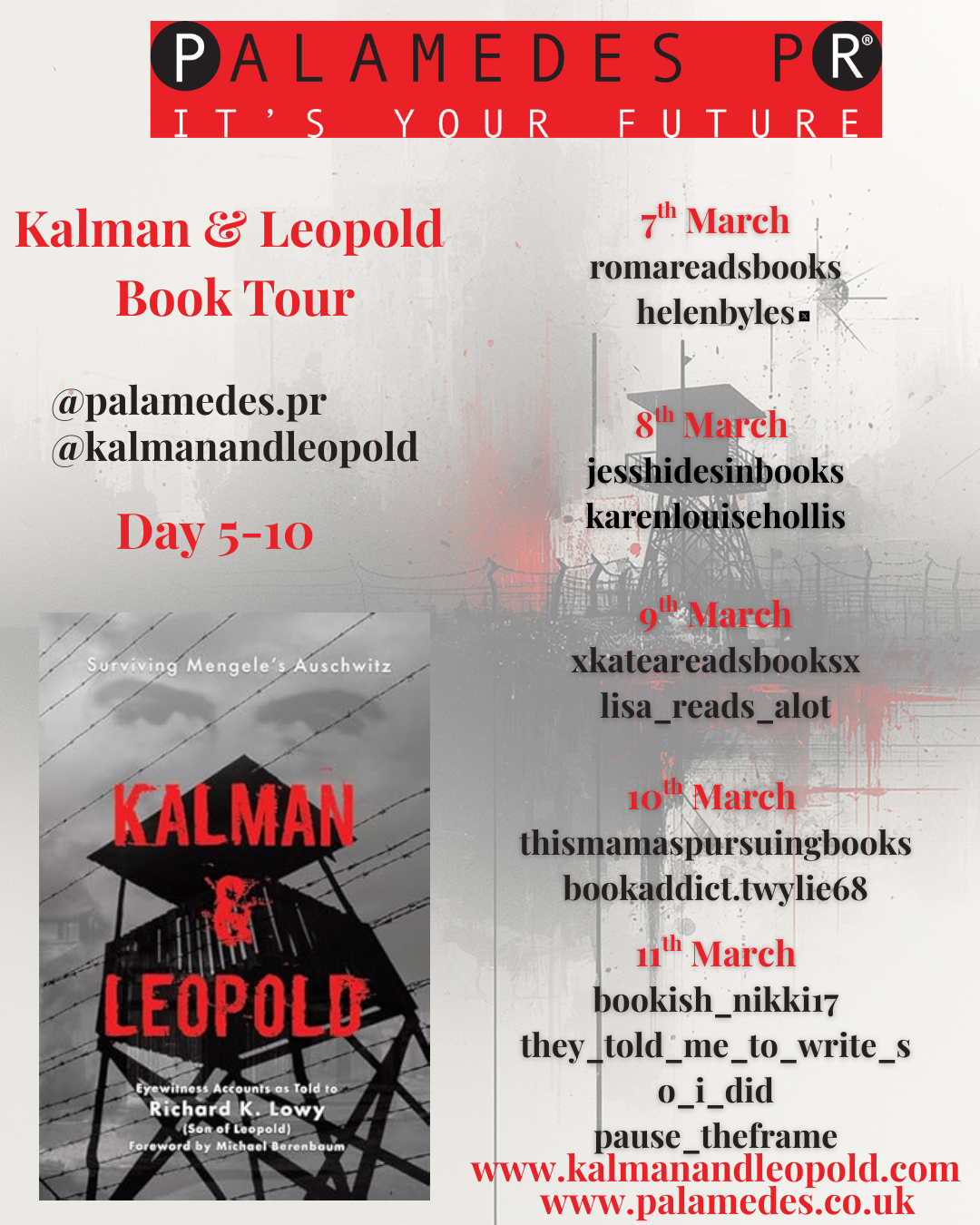
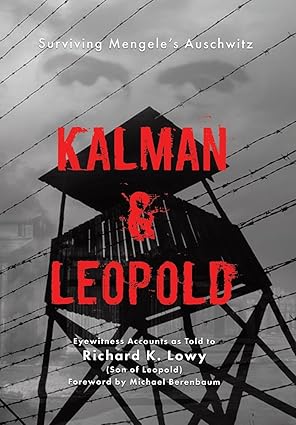
About Kalman & Leopold: Surviving Mengele’s Auschwitz by Richard K. Lowy
For fifty-six years, Kalman searched for “Lipa,” the boy who had protected him, driven by a single need—to say thank you.
In the shadow of Nazi Germany’s largest death camp, Auschwitz-Birkenau, Kalman and Leopold—two young boys meet as unwitting subjects of Germany’s twisted eugenic twin experiments.
But their story begins long before they arrive at the camp. Born in vibrant Jewish communities—Kalman a 13-year-old religious yeshiva student from Balassagyarmat, Hungary devoted to his faith, Leopold a streetwise 15-year-old from Berehova, Czechoslovakia—these boys carried with them the richness of pre-war life: families, friendships, traditions, and hopes.
Written with unflinching honesty and told in the first-person voices of Kalman & Leopold, the book opens in pre-war Europe and takes the reader through the rise of antisemitism, deportation and selection on the ramp at Birkenau, where their families—save for their twin sisters and Kalman’s mother—are immediately condemned to the gas chambers. Marked as twins, the two boy’s lives are spared for reasons unknown to them.
An immersive journey, Kalman & Leopold, is a spellbinding account of three interwoven stories, including that of Auschwitz’s infamous Dr. Josef Mengele. His story traces the transformation of a wealthy German boy with a fascination for art, music, and anthropology into the infamous “Angel of Death,” whose brutal experiments reach out to seize Kalman and Leopold, putting them at the mercy of one of history’s most monstrous figures.
Kalman and Leopold are subjected to medical procedures in his laboratories—experiments carried out without anaesthesia, without mercy. Of approximately 3,000 individual twins subjected to his experiments, only 120 survived. Fewer than a handful documented their firsthand experience, this is one of those rare insights.
One morning, an SS guard singles Kalman and Leopold out from roll call, selecting them to serve inside Mengele’s hospital camp’s guard shack—a nightmarish vantage point in the heart of Auschwitz II–Birkenau. They become forced witnesses to the machinery of death at the height of summer 1944, as over 475,000 Hungarian Jews arrive in Birkenau, train after train disgorging families condemned to the gas chambers, crematoria and the open fire pit, a large outdoor pyre where victims’ were burned alive when the crematorium could no longer keep up with the mass killing.
This SS guard shack stands less than one hundred metres from Crematorium IV and the fire pit. They cannot see the actual fire pit, but every day for three months they hear the screams. They witness the endless trains, the brutal selections, the liquidation of the Roma (Gypsy) camp, the desperate uprising of the Sonderkommando and the daily line of trucks packed with thousands of unsuspecting souls being delivered to the crematoria and pit, returning empty to collect the next load.
Within this nightmarish hell, Leopold—streetwise and hardened—becomes reluctantly responsible for Kalman, fearing this naïve religious boy will attract deadly attention from the guards. Forced to guide him through the SS guard shack’s terrifying complexities and the surrounding horrors, Leopold teaches Kalman survival tactics even as he resents the burden. For six and a half months, they learn the habits of their individual SS guards, bear witness to methodical acts of murder, and endure brutal beating that are interrupted by brief, unexpected human connection. Slowly, against all odds, a genuine friendship emerges.
In January 1945, the Russian army stumbles upon Birkenau, the camp is liberated, and the boys part ways. Kalman assumes he will never see ‘his Lipa’ again. Leopold immigrates to Canada with his twin sister—orphaned, traumatized, carrying memories he cannot yet articulate. Yet he rebuilds. He marries, raises a family, becomes a devoted member of his community, integrates himself into ordinary Jewish life despite the extraordinary darkness he has witnessed and experienced.
Kalman, carrying that same forged resilience, arrives in Palestine on the eve of the 1948 War of Independence, a land teetering on the brink of all-out conflict as Jewish fighters prepare to defend the emerging state against overwhelming odds. Rejecting quiet recovery, the former devout religious boy—transformed by Auschwitz—volunteers as a pilot for the fledgling Israeli Air Force, signing up to join the desperate cause, channeling his will to live into defending his people’s future.
The book reveals this essential dimension: that survivors do not merely endure but build—that resilience is not passive survival but active reconstruction of meaning, family and community.
Kalman spent his life searching for “Lipa”, a nickname he had given the boy who had protected him. His search remained unanswered until 2001, when, by a remarkable stroke of chance, he recognized Lipa’s youthful face on his television screen in the documentary Leo’s Journey: The Story of the Mengele Twins, narrated by Christopher Plummer—finally bringing an end to a lifetime spent seeking his boyhood hero. In 2002, they reunite in Vancouver: two men in their seventies, eyes meeting across decades, brothers by fate, the only living souls who fully comprehend the other’s unimaginable burden.
As intolerance and hate intensify in the world, Kalman and Leopold’s voices echo across generations, urging us to understand not only what happened, but how it happened—the years of antisemitic propaganda, misinformation, and the incremental steps taken to influence independent thought. Their story shows how ordinary people can become capable of extraordinary evil, and architects of genocide.
Useful Information
Kalman & Leopold: Surviving Mengele’s Auschwitz is a true testimony that plunges readers into the harrowing world of two teenage boys, each with twin sisters, trapped in Auschwitz-Birkenau under the control of Dr. Josef Mengele. Their narrative places readers inside the ghettos, cattle cars, barracks, the SS guard shack, and Mengele’s twin experiments—and then reveals their additional strength to survive and rebuild after the war.
Pre-War Communities, Lived Experience:
The book begins by immersing readers into vibrant Jewish communities. Readers are introduced to pre-war lives—the warmth of families, the bonds of friendship, the rhythms of religious tradition, and the ordinary joys of daily existence. In Kalman and Leopold’s hometowns, a municipal ordinance would change all this, “all Jews must assemble within 48 hours.
”Why This Testimony Is Rare:
Fewer than a handful of Mengele twins’ survivors have documented their firsthand experience from inside Auschwitz Birkenau’s hospital camp and laboratories. This book presents one of the most comprehensive accounts ever recorded—by two boys—together—capturing their experiences under Mengele not in hindsight, but as they unfold. Told from within the moment, it places the reader inside the guard shack, the labs and the daily reality of Birkenau, revealing events as they happened, not as they were later remembered.
The Unique Vantage Point:
For six and a half months, they occupied a singular position: able to observe, over the guards’ shoulders. This prolonged proximity to perpetrators and processes is extraordinarily rare in survivor testimony.
Relatable, Immediate, Visceral:
Told with the intimacy of a teenage perspective, their narrative is accessible to young readers while offering the depth demanded by educators and historians. Two boys who would never have been friends forge a fragile bond amid brutality. Their experiences illuminate challenges that remain familiar for today’s youth: navigating fear, learning whom to trust, and discovering courage and loyalty under pressure.
Post-War Rebuilding: Life After Atrocity:
Leopold and Kalman did not merely endure—they actively rebuilt lives of purpose and community, demonstrating resilience beyond survival. These testimonies show survival as deliberate reconstruction: families formed, belonging reclaimed—proof that human capacity persists even after annihilation.
How Evil Happens / Propaganda and Complicity:
Through Kalman’s detailed testimony, we learn how propaganda and administrative deception convinced ordinary people to become complicit in genocide. In an era of misinformation and polarization, this granular analysis—grounded in lived experience rather than abstraction—is urgently relevant. The book shows readers not only what happened, but how it happened. Experiences that reveal just how easily prejudice, falsehoods, and indifference escalated into violence. This story is a stark warning: it begins in everyday words and actions.
Unexpected Reunion:
The book is full of extraordinary moments of serendipity, none more remarkable than Kalman’s chance recognition of Leopold’s youthful face on television. This fleeting glimpse led to an unexpected, joyful yet bittersweet reunion fifty-six years later—a reunion that almost didn’t happen. Together they had recounted their experiences, leaving the world a rare and invaluable testament. Six months later, Leopold passed away.
For Whom This Book Matters:
This book matters to students and young readers who need to see how whispers of hate, casual cruelty, and everyday bullying can escalate into unimaginable violence. It matters to educators, historians, and museum curators who must teach not just the horrors of history, but how intolerance and small acts of cruelty grow into complicity and systemic evil. It matters to policymakers, ethicists, and change-makers who must understand that unchecked hatred begins in ordinary words and actions—the margin between indifference and complicity is dangerously thin—and that the bullies of today can become the perpetrators of tomorrow.
Key Statistics
• After the war, Leopold went on with his life. Kalman could not let go. For fifty-six years, he searched for “Lipa,” the boy who had protected him in Auschwitz, driven by a single need—to say thank you.
• A rare comprehensive account of two young boys experiencing Mengele’s experiments, hospital camp and guard shack operations inside Auschwitz Birkenau for 6.5 months
• Transcribed from 20+ hours of video testimony of Kalman Bar-On and Leo Lowy now archived at the United States Holocaust Memorial Museum in Washington DC.
• 3,000 individual twins subjected to Mengele’s experiments less than 120 survived.
Kalman, his twin sister Judith, Leopold and his twin sister Miriam are four of those 120.
• Their SS guard shack located less than 100 metres from the entrance to Crematorium IV & fire pit.
• Only 4 holocaust survivors returned to Leopold’s hometown of Berehova.
• Leopold Lowy: Canada’s last surviving “Mengele twin”
Leopold died December 2002, six months after being reunited with Kalman.
• Kalman’s lifelong quest to find Lipa did more than end in a reunion—it gave the world this story.
About the Author
Richard K. Lowy is an internationally acclaimed producer and creative director whose award-winning work in the global event industry has shaped powerful, emotionally resonant experiences for audiences around the world. After decades of professional success, Richard stepped away from a long-established career path when he uncovered the full truth of his father’s past—choosing instead to devote himself to preserving Holocaust memory at a moment when firsthand witnesses are rapidly disappearing.
The son of Auschwitz survivor Leopold Lowy, Richard set out to understand a story his father had carried largely in silence for decades. That search led him to retrace his father’s journey—returning with him to his hometown and to Auschwitz—where Richard applied his creative instincts and production expertise to capture the experience on film. Working alongside a gifted director and crew, he helped bring to life Leo’s Journey: The Story of the Mengele Twins, narrated by Christopher Plummer.
What began as a deeply personal exploration became something far greater. The film was seen by Kalman Bar-On, a fellow Mengele twin survivor, who recognized the image of a young Leopold as his long-lost friend “Lipa.” Kalman had spent decades searching for his missing campmate. Their reunion—56 years after their separation—did more than reunite two boys who survived the unimaginable; it uncovered an extraordinary story of survival that had come perilously close to disappearing from history.
That rediscovery became the foundation for the book, Kalman & Leopold: Surviving Mengele’s Auschwitz.
Drawing on his extensive background in production and storytelling, Richard ensured that Kalman and Leopold’s experiences—surviving Mengele’s hospital camp, twin experiments, and an SS guard shack—were conveyed with both historical rigor and emotional truth. He guides readers directly into their lived reality without embellishment or reinterpretation, rigorously verifying every detail and preserving each voice exactly as it was spoken and remembered.
For Richard, this work is not a project—it is a responsibility. In an era marked by rising antisemitism and the erosion of historical truth, his work stands as both education and warning, connecting the lessons of the past to the moral urgency of the present.
An international speaker, Richard brings these stories to audiences around the world, presenting at synagogues, schools, Holocaust education centers, and major book events across North America, the United Kingdom, Europe, South Africa, and Israel. Through his writing, filmmaking, and speaking, he is ensuring that the voices of Kalman and Leopold endure—reaching new generations long after the last eyewitness is gone.
Biography: Richard K. Lowy is the son of Auschwitz survivor Leopold Lowy and the driving force behind Kalman & Leopold: Surviving Mengele’s Auschwitz. Bearing the weight of his father’s testimony, Richard has dedicated himself to preserving Holocaust memory for a new generation at a time when eyewitnesses are vanishing. His work bridges personal legacy, historical accuracy, and educational impact, bringing to light the story of two teenage boys—Kalman and Leopold—who survived Mengele’s hospital camp, twin experiments, and SS guard shack, only to be unexpectedly reunited 56 years later through the documentary Leo’s Journey, narrated by Christopher Plummer.
For Richard, this book is more than a story—it is a mission and a warning from the past to the present. He guides readers into the lived experiences of the boys without altering their testimony, ensuring every detail is historically verified, every memory preserved, and every voice heard. In a time of rising antisemitism and historical distortion, Richard’s work ensures these truths resonate, educate, and warn.
An international speaker, Richard brings these stories to life for students, educators, and community organizations. He has presented at synagogues, schools, Holocaust education centres, and major book events across North America, the UK, Europe, and South Africa, connecting audiences directly to the lived realities behind the pages. He lives in Vancouver, British Columbia, Canada.
Target Audiences
Primary:
¬ Literary reviewers, book bloggers and social media influencers reaching general and young audiences
¬ General readers of non-fiction and history
¬ Students and educators
¬ Holocaust education organisations and institutions
¬ Jewish community audiences, UK-based and international diaspora
Secondary:
¬ Policy-makers and cultural commentators
¬ Museums, archives and academic readers
¬ Podcast and broadcast audiences interested in history and testimony
From Richard:
“I want to preserve the authentic testimony of Kalman and Leopold for future generations, combating historical distortion and antisemitism and ensuring that the lived reality of Auschwitz continues to educate and warn as eyewitnesses disappear. My hope is that readers will understand the human reality behind Holocaust history, recognise the consequences of hatred and indifference, and carry forward the responsibility of remembrance.”

 Bookchatter@Cookiebiscuit