
A Gothic mystery set in the labyrinthine alleys of 1840s Naples — the first modern English translation of Mastriani’s masterwork.
Naples, 1840. In the anatomy hall of the Hospital for the Incurables, a young medical student stands over his dead sister’s body and makes a vow. What follows is one of the most gripping novels of the Italian Romantic era: a story of hidden identity, buried crimes, a blind woman of extraordinary perception, and a city where justice moves slowly but with terrible force.
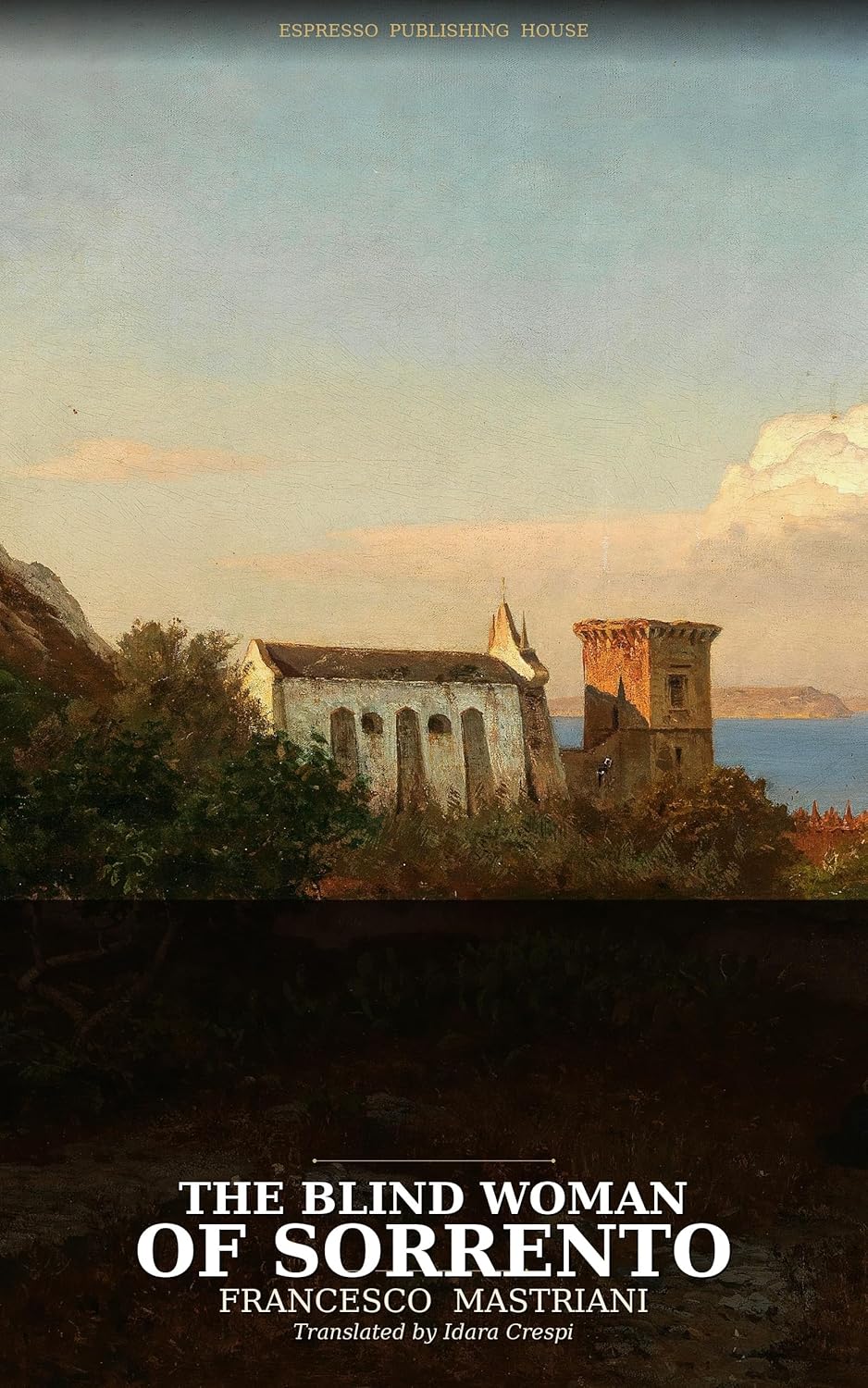
Beatrice Rionero has been blind since childhood, raised by her widowed father in a villa above the Bay of Sorrento. When a mysterious foreign physician arrives — Dr. Oliviero Blackman — he claims to offer her the chance of sight. But Blackman is not what he appears. And neither is anyone else in this labyrinthine story of secrets, vengeance, and redemption.
Francesco Mastriani (1819–1891) was the great chronicler of Neapolitan society — a writer sometimes compared to Dickens and Eugène Sue, whose serialized fiction drew enormous popular audiences while unflinching in its portrait of class, injustice, and the hidden lives of the poor. La Cieca di Sorrento (1852) is his most celebrated novel: a work of Gothic sensation and moral seriousness, set in the streets and drawing rooms, courtrooms and catacombs of nineteenth-century Naples.
This first modern literary English translation, by Idara Crespi, restores the full force of Mastriani’s prose — its declarative rhythms, its operatic emotional peaks, its dark comedy, and its portrait of a blind woman whose inner sight surpasses everyone around her.
Part One
An extract from Chapter I — The Medical Student
In that labyrinth of endless alleys, lanes, and passages no wider than an outstretched pair of arms — bearing their hundred barbarous names, grim vestiges of foreign peoples — through which one always passes with a certain unease of spirit, as when visiting a prison or a hospital; in that mass of squalid and blackened houses heaped one upon another, so grudgingly touched by sunlight; in those quarters where the eye and thought of wealth rarely penetrate, yet whose damp walls shelter honest families of humble day-labourers; in that network, in short, of densely peopled ancient alleyways that compose the districts of the Mercato, the Pendino, and the Mandracchio, and which go by the single common name of Old Naples — there lies a little lane, or rather a burrow, one of that thousand that raise a species of dread in the breast of even the Neapolitan who visits them for the first time. This crooked, ill-omened, and fetid lane bears the name of Vico Chiavetta al Pendino: you would search in vain, dear reader, for it in that Hispano-Gallic-Latin almanac of viceregnal memory, unless you happened upon it by some accident of chance.
An hour past midnight of the tenth of November, 1840.
The land-wind blows violently through the old arches of those medieval buildings, howling like an enraged demon over the sleeping city and rattling the ancient shutters of the windows. The silence of that street reigns absolute and solemn in the intervals that the wind leaves between its cries…
It is the hour when the race of the wretched and the suffering finds in sleep the balm for its wounds.
But what is that man doing, bent over that table on which the stub of a tallow candle sputters? What is that thing thrown across the table? Good heavens — a head!.. a human head!.. and the blood is still clotted at the part severed from the trunk!… And a knife… he holds it in his hands! Do not be alarmed… That man is no assassin… He is simply a student of medicine.
In the pale light of the candle, his face reveals itself: dark, lean, hollow-cheeked, and ugly. His head is covered with red hair — coarse and tightly curled; his upper lip protrudes outward, fleshy, and nearly meets the tip of a large aquiline nose. The rough bristles of his moustache seem to find no room to settle between those two prominences and twist themselves in every direction, composing themselves almost in the form of a hedgehog’s quills. His eyes, rather noticeably cross-eyed, are nonetheless full of vivacity and extremely mobile beneath a wide, broad forehead, in the center of which a deep furrow opens like a wound — or like the mark of a curse with which God has branded it. In the whole of this human being’s physiognomy one reads at first glance the hatred he has conceived for all beauty, and that irascibility of character natural to the deformed; but, studying his features more closely, one is struck by the expression of profound sagacity with which they are impressed, and by that solemn authority that clothes the face of those men who have made science their constant occupation.
The miserable candle serves more to cast sinister shadows about the room than to illuminate it; a few quarto-sized books are piled in one corner against the wall; several lie open on the table, indicating that the young man has only recently ceased drawing from them his intellectual nourishment.
The walls of the room, wavering between black and white, gave it more the aspect of a prison than a dwelling — all the more so as the floor was cold, damp, and without tiles.
Poverty without doubt, with all its court of deprivations, hardships, and sufferings, reigned in that house; that squalor, that wretchedness, those reminders of death, that night so gloomy and dark, those plaintive voices the wind drove through the shutters — all of it seemed to place upon the lips of that house’s master the biblical words: My soul is sorrowful on every side, even unto death: stay here, and watch with me.
And indeed, in the way the young man would sometimes turn his almost frightened eyes around and around the room, it seemed as though he had called upon some companion to remain and keep watch with him.
This man — who might appear at first glance to be already of mature years — has only a little past his fifth lustrum; his name is Gaetano, and he is from Calabria. For some two hours he has not moved from beside that table, his eyes fixed immovably upon that livid head. But what is he doing? Why has he suddenly started and thrown a worn rag over that head, casting a glance toward a corner of the room?
Ah! — a woman, an old woman, lies asleep on a poor straw pallet thrown on the ground, wrapped in a scrap of the coarsest woollen blanket. In her sleep she had called Gaetano’s name, and he, believing her awake, had turned sharply toward her — not without a movement of alarm, for he had two reasons for hiding that anatomical specimen from her.
That woman was his father’s mother.
The woman was still sleeping, and Gaetano, who had crossed on tiptoe to see whether she had woken, returned to his place and uncovered once more that remnant from the hospital. He sinks back onto his chair; he rests his head in his two open hands, and immerses himself anew in the dark meditation inspired by that gloomy and mutilated companion.
Why do two great tears fall cold and heavy from his eyelashes, worn with wakefulness? Why does his hair stand upon his pale forehead? Why do his eyes make a convulsive turn in their sockets, and then close — as though to flee from some object of horror?
Dreadful memories coil about in that head, and gather there like dense storm-clouds heralding an imminent tempest.
A full hour passes in that mute and savage contemplation of the fleshed skull; but sleep descends upon Gaetano’s eyelids; nature reclaims her rights; and one must obey.
The full novel continues with 38 chapters of Gothic mystery, concealed identities, and a labyrinthine plot across Naples and the Sorrento coast.
The Blind Woman of Sorrento is available now in Kindle and paperback from www.amazon.co.uk and www.amazon.com
ESPRESSO PUBLISHING HOUSE

 Bookchatter@Cookiebiscuit