The year is 1969. In the state of Kerala, on the southernmost tip of India, a skyblue Plymouth with chrome tailfins is stranded on the highway amid a Marxist workers’ demonstration. Inside the car sit two-egg twins Rahel and Esthappen, and so begins their tale. . . .
Armed only with the invincible innocence of children, they fashion a childhood for themselves in the shade of the wreck that is their family—their lonely, lovely mother, Ammu (who loves by night the man her children love by day), their blind grandmother, Mammachi (who plays Handel on her violin), their beloved uncle Chacko (Rhodes scholar, pickle baron, radical Marxist, bottom-pincher), their enemy, Baby Kochamma (ex-nun and incumbent grandaunt), and the ghost of an imperial entomologist’s moth (with unusually dense dorsal tufts).
When their English cousin, Sophie Mol, and her mother, Margaret Kochamma, arrive on a Christmas visit, Esthappen and Rahel learn that Things Can Change in a Day. That lives can twist into new, ugly shapes, even cease forever, beside their river “graygreen.” With fish in it. With the sky and trees in it. And at night, the broken yellow moon in it.
The brilliantly plotted story uncoils with an agonizing sense of foreboding and inevitability. Yet nothing prepares you for what lies at the heart of it.
The God of Small Things takes on the Big Themes—Love. Madness. Hope. Infinite Joy. Here is a writer who dares to break the rules. To dislocate received rhythms and create the language she requires, a language that is at once classical and unprecedented. Arundhati Roy has given us a book that is anchored to anguish, but fueled by wit and magic.
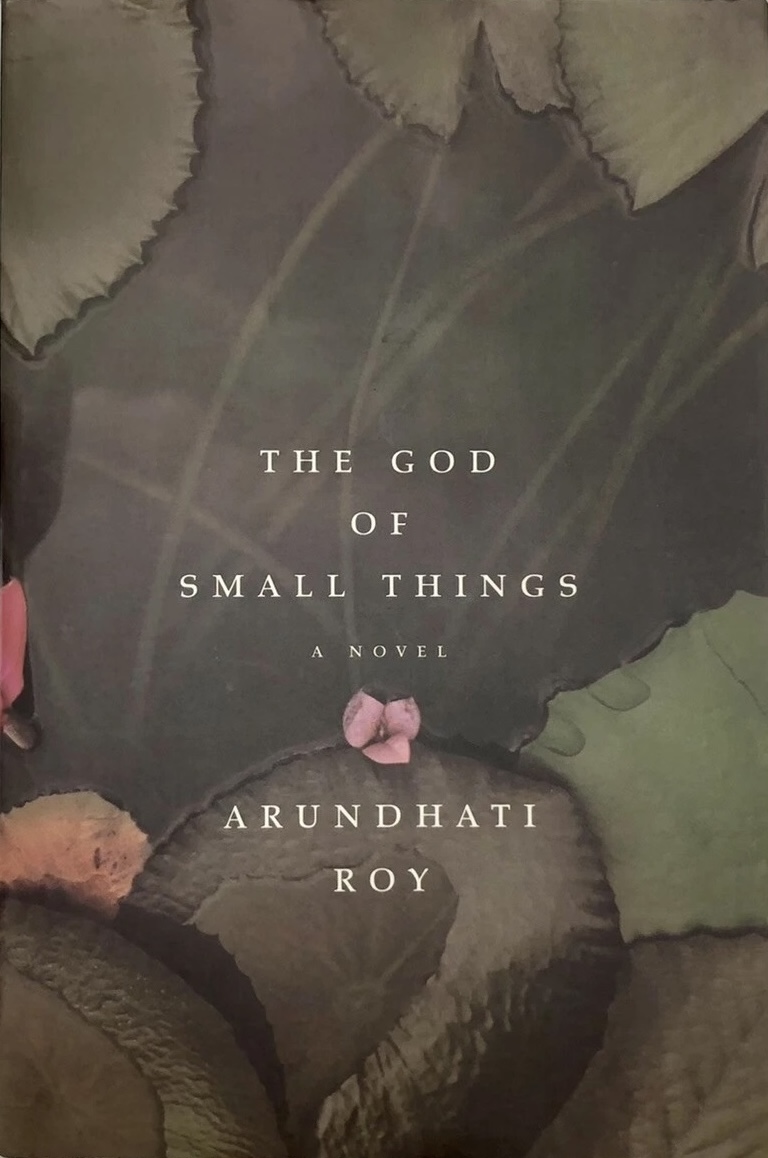
My Review
I first read this many years ago, but I chose it as my book club read as others were keen to read it (some had read it before like me) and I fancied reading it again.
I didn’t like it as much as I did when I read it in the late 1990s. Not because it’s dated – it’s set partly in 1969, when the children are eight or nine, so that wouldn’t apply. Perhaps because I have read many more books since then.
We also jump forward to 1993 when Rahel is an adult, and Esthappen returns after being sent away in 1969. Their connection is broken and he doesn’t speak. Their mother Ammu died alone years before.
I remembered little apart from the fact that the family were Syrian Christians in a Hindu country. I remembered the twins but not the death of Sophie Mol.
I found the prose brilliant and unusual, but sometimes the descriptions were over complicated and repetitive – the Love-in-Tokyo, the pointy shoes, the Elvis references and the quiff, the two-egg non-identical twins etc. Over and over. The capitalised words. It made it exhausting to read, and I wanted to move the story forward. It also made it complicated. And I would forget where it had gone before. It would be disingenuous if I said I found it a bit gimmicky at times. I so wanted to be wrong.
Any swearing – use of the f word and the c word I found unnecessary for the context. And then the all important question – did they or didn’t they?
About the Author
Arundhati Roy is an Indian writer who is also an activist who focuses on issues related to social justice and economic inequality. She won the Booker Prize in 1997 for her novel, The God of Small Things, and has also written two screenplays and several collections of essays.
For her work as an activist she received the Cultural Freedom Prize awarded by the Lannan Foundation in 2002.